Skip to content
Admission open Session 2083 admission is open for Nursery to Grade 12

Courses from Nursery to Grade 12

Four levels on one campus, all taught under the national curriculum. A child can join us at Nursery and finish plus two without ever changing school.

At a glance

The four levels we teach

LevelClassesCurriculumBoard examination
Pre-primaryNursery, LKG, UKGPlay and activity basedNone
PrimaryGrade 1 to Grade 5National curriculumNone
SecondaryGrade 6 to Grade 10National curriculumSEE at Grade 10
Plus twoGrade 11 and Grade 12NEB, four streamsNEB Grade 11 and 12

Level one

Pre-primary, Nursery to UKG

The first years decide how a child feels about school for the rest of their life. We keep it warm, busy and full of play.

Children pick up rhymes, colours, drawing, early letters and early numbers through activities rather than long writing drills. Just as important, they learn to share, to speak in a group, to line up, and to sit through a class before formal school begins.

Our UKG students graduate in a small ceremony at the end of the year, which is often the first time a child stands on a stage in front of their parents.

  • Rhymes and stories
  • Drawing and colouring
  • Early numbers
  • Letter formation
  • Music and dance
  • Group play
Pre-primary children at Supreme Academy
Primary class at Supreme Academy

Level two

Primary, Grade 1 to Grade 5

The years where reading, writing and number sense have to become solid. If these are shaky, everything after Grade 6 becomes harder.

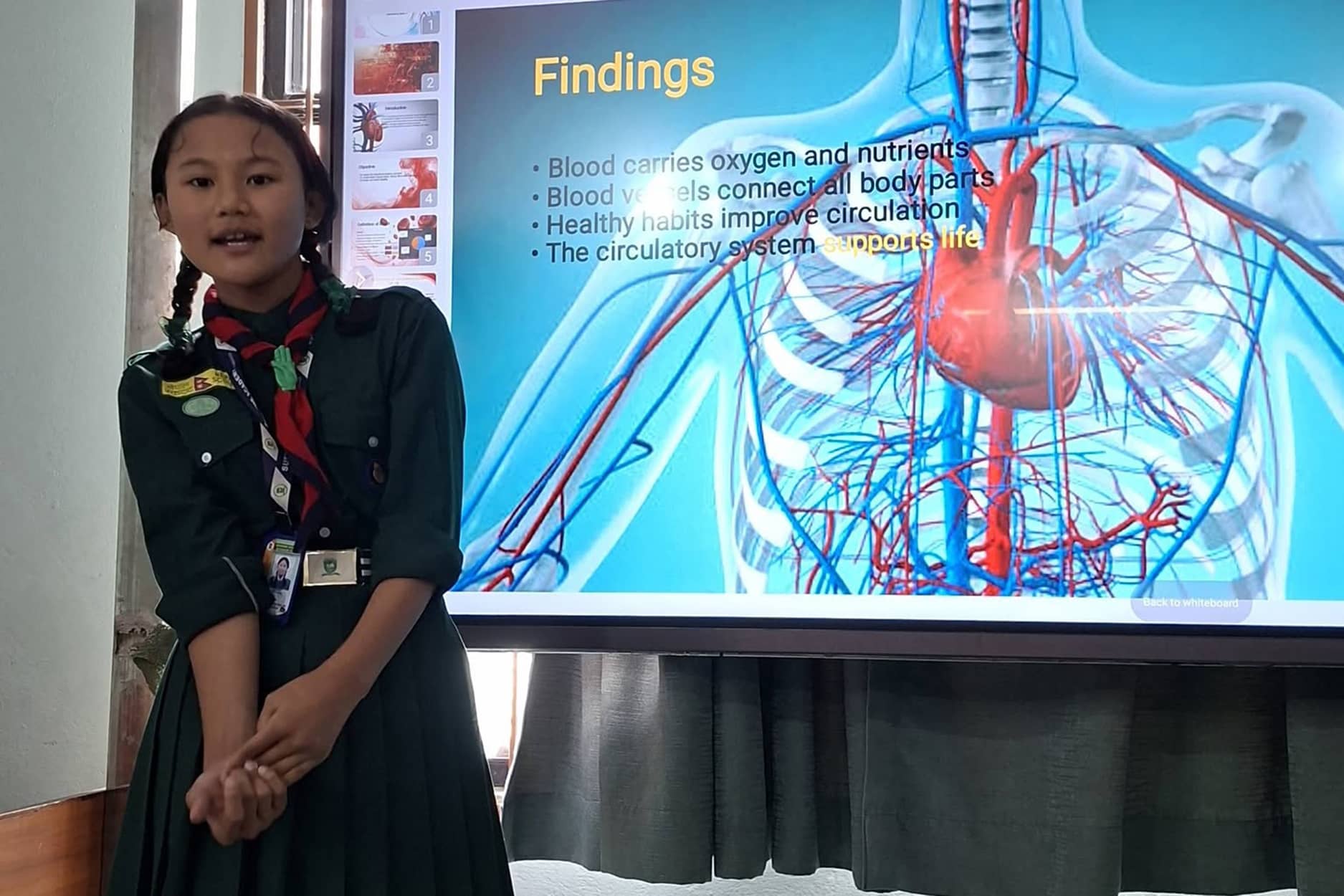
Alongside English, Nepali, Mathematics, Science, Social Studies and Health, our primary students take a handwriting class and abacus training, both run with NCMAS. Project work and class presentations start here, in a simple form, so that speaking in front of people never feels strange later on.

Educational tours for these classes stay inside the Kathmandu valley, at educational and cultural sites the children can visit and return from in a day.

  • English
  • Nepali
  • Mathematics
  • Science
  • Social Studies
  • Health and Physical
  • Computer
  • Handwriting
  • Abacus
  • Art

Level three

Secondary, Grade 6 to Grade 10

The full secondary course leading to the SEE examination at the end of Grade 10.

Students work in the science lab and the computer lab as a normal part of their week. Grade 6 and 7 students build working robotics projects with Arduino, including a gas leak detector that sounds a buzzer and a distance measuring system that uses sound waves. Grade 4 upward also cover cyber safety, so students understand what a virus does and how to stay safe online.

Every student from Grade 1 to Grade 10 prepares project work and presents it in class. Level wise competitions run through the year in quiz, oratory, news reading, poetry recitation, drawing, handwriting, table tennis, futsal and basketball.

Our SEE students have been finishing between 3.9 and 4.0 GPA since 2074 BS.

  • Compulsory English
  • Compulsory Nepali
  • Mathematics
  • Science and Technology
  • Social Studies
  • Computer Science
  • Optional Mathematics
  • Health and Physical
  • Robotics
Secondary students in the laboratory

Level four

Plus two, Grade 11 and Grade 12

Four streams under the National Examination Board curriculum. Compulsory English, Nepali and Social Studies run across all of them, and career counselling is part of the programme rather than an afterthought.

EDIT: please confirm the exact subject combinations offered this session with the school office, then correct the four blocks below. Subject choices can change from year to year.

Stream 01

Science

For medicine, engineering, IT, agriculture, forestry and pure science.

Subjects

Compulsory English, Compulsory Nepali, Physics, Chemistry, and then either Biology or Mathematics. Computer Science is available as an option in place of one subject.

Where students go next

MBBS and other health science courses, BE and engineering, BSc CSIT and BIT, BSc in physical and life sciences, agriculture and forestry, and entrance preparation for IOM, IOE and CTEVT programmes.

What we provide

Practical work in the science lab, the computer lab for IT subjects, and regular internal testing so students are ready for competitive entrance examinations, not only for the board.

Stream 02

Management

For business, banking, accountancy and administration.

Subjects

Compulsory English, Compulsory Nepali, Accountancy, Economics, and Business Studies, with Business Mathematics or Computer Science as the optional subject.

Where students go next

BBA, BBS, BBM and BIM, chartered accountancy and ACCA, banking and finance, hotel management, and family business.

What we provide

Practical accountancy work, group projects on real business problems, presentations, and counselling on which bachelor programme fits which career.

Stream 03

Law

For law, public service and the constitutional field.

Subjects

Compulsory English, Compulsory Nepali, and legal studies subjects covering the introduction to law, the legal system of Nepal, and the constitution, alongside social science subjects such as Sociology and Economics.

Where students go next

BA LLB and other law programmes, public service preparation, and social science degrees.

What we provide

A strong reading and writing base, debate and oratory practice, and awareness programmes run with the local police and municipality on the law as it affects young people.

Stream 04

Humanities

For social science, media, teaching and civil service.

Subjects

Compulsory English, Compulsory Nepali, and a choice from Sociology, Psychology, Mass Communication, Rural Development, Political Science and Population Studies.

Where students go next

BA in social science, journalism and mass communication, psychology, education and teaching, development work, and civil service preparation.

What we provide

Research based project work, field visits, writing practice, and the school newsletter, where students publish their own articles, stories, poems and drama scripts.

Beyond the syllabus

Classes that run alongside the main course

Digital ICT course

Run in the ICT lab in partnership with CCA Nepal, covering practical computer skills.

Handwriting class

Structured handwriting training with NCMAS. Our students place at district level handwriting competitions.

Abacus

Mental arithmetic training that speeds up calculation and builds concentration in younger students.

Robotics with Arduino

Grade 6 and 7 build gas leak alarms, distance sensors and car parking sensors, and learn the programming behind them.

Wushu and sports

Wushu, futsal, basketball, table tennis and kabaddi, with teams that compete at municipal and district level.

Art, dance and drama

Drawing and painting, single dance, folk dance and drama, all with internal and inter school competitions.

How students are assessed

Tested inside the school, and outside it

Any school can mark its own students generously. We deliberately send our students into examinations we do not control.

Internal

Regular class testing

Unit tests, terminal examinations and continuous assessment through project work, presentations and classwork. Parents are told early when a child starts slipping.

External

Centralised evaluation

Yearly centralised evaluations and examinations run with Shikshya Bikash Sanjal and G8 Edu Forum, so our results are compared against other schools.

Board

SEE and NEB

The SEE examination at the end of Grade 10, and the National Examination Board examinations at the end of Grade 11 and Grade 12.

Admission

How to enrol your child

Call or send an enquiry

Phone 01-6634125 or fill the enquiry form on our contact page. Tell us which class you are applying for.

Visit the school with your child

Come and see the classrooms and meet the level incharge. Bring your child along so they can see the place too.

Collect and fill the admission form

Forms are available at the school office. Bring the previous marksheet, transfer certificate, character certificate, birth certificate and passport size photographs.

Entrance test or interaction

For Grade 1 upward there is a short entrance test or an interaction, depending on the class. Pre-primary admission is by interaction with the child and parents.

Confirm the seat

Complete the fee formalities at the office and collect the book list, uniform details and academic calendar.

Course questions

What parents ask about our courses

Can my child change stream after joining Grade 11?
A change is possible only in the first weeks of Grade 11 and only if there is a seat in the other stream. Speak to the plus two level incharge as early as possible, because the board registration fixes the stream after that point.
Do you prepare students for entrance examinations?
Our Science and Management students sit regular internal tests built around the pattern used in entrance examinations, and we run career counselling sessions so students know what each bachelor programme asks for.
Is there an entrance test for admission?
For Grade 1 and above there is a short written test or an interaction, depending on the class applied for. Pre-primary admission is by a friendly interaction with the child and parents, with no written test.
What is the medium of instruction?
English is the medium of instruction for all subjects except Nepali and Social Studies, which follow the national curriculum in Nepali.
How are the fees structured?
Fees differ by level and are set at the start of each session. Please contact the school office on 01-6634125 for the current fee structure, and ask about the scholarship provisions available for students who qualify.
Do students get educational tours every year?
Yes. Nursery to Grade 5 travel within the Kathmandu valley. Grade 6 and 7 have visited Chandragiri and Chitlang, Grade 8 and 9 have gone to Chitwan and Bandipur, Grade 11 to Pokhara, Beni and Mustang, and Grade 12 to Dharan, Ilam, Darjeeling and Janakpur. Students prepare project work based on what they saw.

Session 2083

Admission is open for every class

Nursery to Grade 12, and all four plus two streams. Seats in each class are limited, so it helps to come early.